






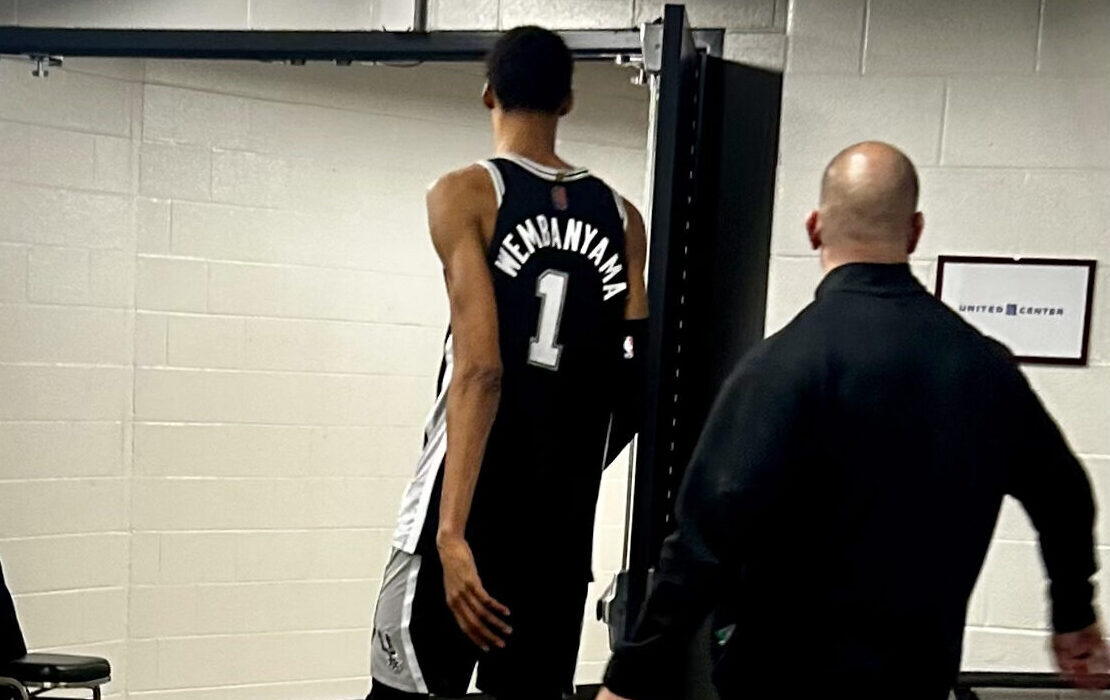
From Dirk Nowitzki and Kevin Garnett to Nikola Jokić and Victor Wembanyama, the NBA has spent decades redefining what it means to be a big man. As the league enters another era of positionless basketball, the Chicago Bulls are without a 7-footer, raising questions about the future of the rebuilding franchise.
CHICAGO—On January 25, 2016, Kevin Durant watched a 7-foot-3 rookie from Latvia do something increasingly more prevalent in contemporary professional basketball: combine extraordinary size with an equally exceptional skill set.
Kristaps Porziņģis shot from the perimeter, handled the ball, made plays for teammates and protected the rim. For Durant, the combination warranted a distinction beyond the conventional positions listed on a roster.
“That’s like a unicorn in this league,” Durant said per ESPN.
The nickname stuck.
Nearly a decade later, the unicorn has become one of the NBA’s most coveted archetypes. What once seemed like an anomaly is now the blueprint for some of the league’s most successful franchises.
The evolution has produced a new generation of big men who operate as primary offensive creators, stretch defenses beyond the three-point line and defend multiple positions. Jokić, Wembanyama, Karl-Anthony Towns, Chet Holmgren and Giannis Antetokounmpo represent different versions of the same fundamental shift. The Oklahoma City Thunder’s 2026 12th overall NBA Draft pick, Aday Mara, Washington Wizards Alex Sarr and Memphis Grizzlies Quinten Post represent foals progressing to unicorn status.
The modern NBA no longer solicits its tallest players to solely occupy the paint. The contemporary game beseeches these aliens to control the entire floor.
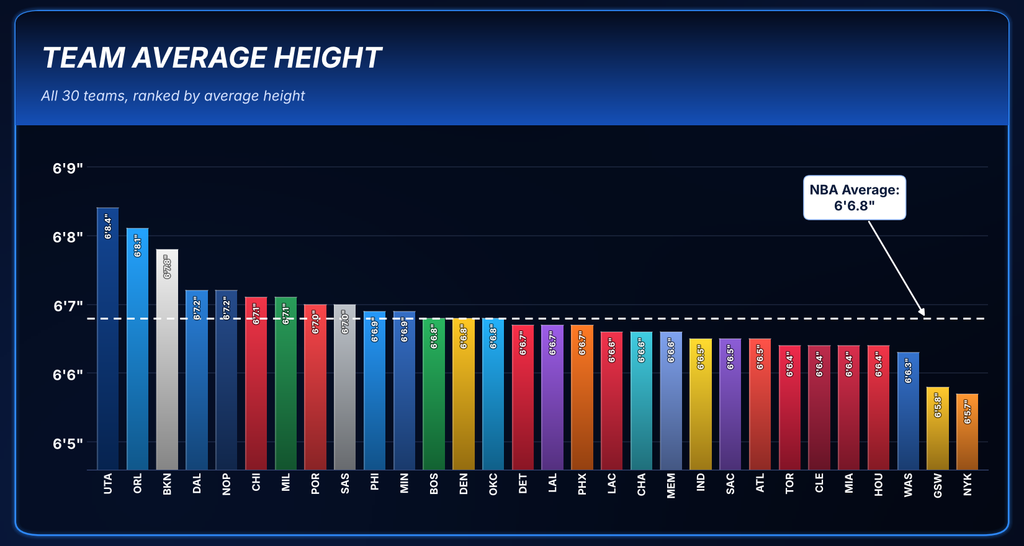
For the Chicago Bulls, the influx of height across the NBA represents a particularly interesting conundrum. According to measurements from NBA.com going into the 2026-27 season, the Bulls were one of nine NBA teams without a player listed at 7 feet or taller. The average roster height of 6 feet 7.1 inches is tied with Milwaukee for the tallest in the Central Division, yet the Bulls have an absence of any 7-footers to anchor their frontcourt.
Bulls forwards:
| Nic Claxton | 6’11” |
| Caleb WIlson | 6’10” |
| Leonard Miller | 6’10” |
| Jalen Smith | 6’9″ |
| Matas Buzelis | 6’9″ |
| Zach Collins | 6’9″ |
| Noa Essengue | 6’9″ |
| Tobe Awaka | 6’8″ |
| Patrick Williams | 6’7″ |
Before the unicorn, there were giants
The NBA’s fascination with oversized players is hardly new. What has changed is how the league expects them to operate.
For the vast majority of basketball history, the center was the foundation of a team’s offense and defense. DePaul University legend George Mikan helped establish the value of size in the early NBA, while Bill Russell and Wilt Chamberlain defined the center position through the ‘60s with contrasting approaches to scoring, rebounding and defense.
Kareem Abdul-Jabbar carried that tradition into the following decades, combining an imposing frame with one of the most unguardable scoring moves in basketball history: the skyhook.
The ‘90s brought another generation of dominant interior players. Hakeem Olajuwon, David Robinson, Patrick Ewing and Shaquille O’Neal made the center position synonymous with physical dominance.
Teams built around tree-like figures frequently fed the post and surrounded interior scorers with perimeter shooters. Defensively, the objective was straightforward: protect the paint, control the glass and make opponents uncomfortable near the basket.
Although, even during the heyday of traditional centers, the foundations of the modern unicorn were beginning to emerge.
Dirk Nowitzki, Tim Duncan and Kevin Garnett entered the league as oversized forwards whose skill sets didn’t neatly fit into conventional positional expectations.
Nowitzki, standing 7 feet tall, developed into one of basketball’s greatest perimeter-shooting big men. The pioneer was able to create his own shot, particularly with the patented one-legged fadeaway, forcing opposing power forwards and centers to defend well beyond their comfort zones.
Garnett, standing 6-foot-11, brought a different combination of skills. The South Carolina native could defend multiple positions, drop dimes, bury midranges and operate as a vocal defensive anchor.
Forwards weren’t given the same freedom that modern fives relish. Nowitzki, Duncan and Garnett’s careers demonstrated the indispensable extent a tall and skilled forward could become when freed from the limitations of traditional positional assignments.
Now, a team’s tallest player could also be one of its most dangerous perimeter threats, revolutionizing the center position in the NBA and beyond.
Nowitzki’s 2011 campaign with Dallas, in particular, demonstrated how a shooting big man could become the centerpiece of a championship offense.
In 2010-11, Nowitzki led Dallas to their first NBA Championship, winning Finals MVP, shooting 46% from three-point range and averaging 27.7 points per game with 8.1 rebounds and 2.5 assists in the postseason.
The stretch center archetype had evolved from a novelty into a genuine competitive advantage.
The nickname that changed the conversation
The term “unicorn” gained mainstream recognition in January 2016, when Durant praised Porziņģis for his rare combination of shooting, playmaking and rim protection.
Durant’s description of Porziņģis was specific, KD was not merely awestruck by a tall player who could shoot. The sharpshooter was captivated by a 7-foot-3 player who could shoot, make the right plays and defend at an elite level.
The Ringer’s 2019 retrospective identified six generational stretch centers on the cusp of unicorn status: Antetokounmpo, Anthony Davis, Joel Embiid, Jokić, Porziņģis and Towns.
Each individual’s game was different, but those six athletes had the ability to transcend traditional positional assignments and control the game on both sides of the floor.
Jokić became an offensive system unto himself, using his passing and court vision to orchestrate Denver’s offense from the five. Antetokounmpo became a transition and defensive nightmare, Davis combined perimeter mobility with elite rim protection, while Towns developed into one of the league’s most dangerous shooting centers.
The positional revolution was no longer exclusively about making guards and forwards interchangeable. Centers now carried responsibilities traditionally reserved for guards: pick-and-rolls, pull-up threes, passing from anywhere on the court, guarding at the three-point line, leaking out in transition and assuming all roles traditionally gatekept by smaller players.
The habitual hierarchy had morphed. The living giants on the floor could now initiate the offense rather than simply finish it.
The modern center is a matchup nightmare
The subsequent phase of the unicorn era is not focused on novelty, but necessity.
Consider Jokić: at 6-foot-11, the Nuggets big man doesn’t fit the traditional physical profile of a dominant center in the mold of O’Neal or Chamberlain. Yet the Serbian’s ability to score from the post, shoot from the perimeter and facilitate offense makes him one of the most difficult players in basketball to defend.
Double-team Jokić and he will find the open shooter with eyes on the back of his head. Play the 31-year-old straight up, one-on-one and it’s barbecue chicken from all three levels.
Towns presents a different obstacle. The 2015 first overall pick, 2026 NBA Champion and Kentucky Wildcat product has the shooting ability that forces opposing centers far away from the basket, opening driving lanes and changing the geometry of the offense. Imperative for drawing other unicorns like Wembanyama away from assuming rim protection duties.
Holmgren and Wembanyama represent another evolution. Their exceptionally lengthy and slender appendages allow the 7-plus-footers to protect the rim while possessing the mobility and perimeter skills to defend outside the paint.
The ideal modern center can punish virtually any defensive coverage.
That versatility has also revived the importance of size in a game that once appeared determined to eliminate the traditional big man.
The small-ball revolution, popularized by Golden State’s 2010’s pace-and-space championship teams, demonstrated the advantages of playing without a conventional center. Draymond Green could defend multiple positions, switch onto guards and facilitate offense. Kevon Looney held his own as an undersized center and the Warriors surrounded Stephen Curry with elite shooters such as Klay Thompson and Durant.
Small-ball basketball didn’t eliminate the need for size. It redefined the circumstances in which size becomes valuable. The Golden State Warriors built a dynasty on this philosophy, cementing their legacy through switch-everything defense, a historic volume of three-pointers and a blistering transition pace.
Current NBA teams now face constant calculation: Can a smaller lineup create enough offensive advantages to compensate for the physical disadvantages it faces inside?
The best contemporary frontcourts eliminate that compromise.
Chicago’s missing piece
While the Chicago Bulls have invested in a young, versatile and athletic core, the Windy City remains notably without a player listed at 7 feet or taller.
In an NBA arms race where size and shooting are no longer mutually exclusive, the Bulls’ absence of a gargantuan five that can stretch the floor is becoming harder to ignore.
To start the 2026-27 NBA, there were 40 players listed at 7 feet or taller, with the Central Division accounting for just three, the lowest number among all the divisions.
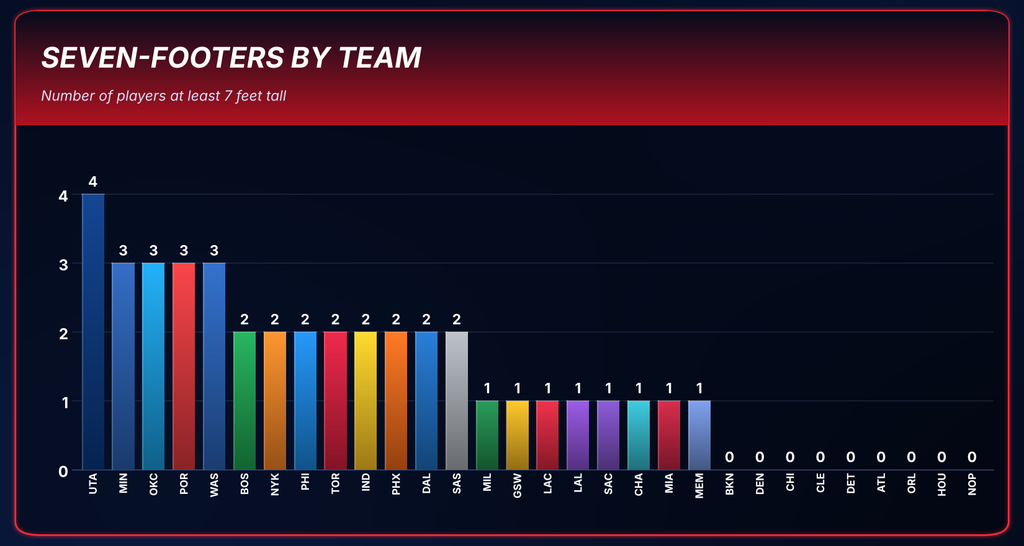
The Bulls are particularly notable in that distribution. Chicago’s average player height is 6-foot-7, tied with Milwaukee for the tallest average in the Central Division, yet neither figure tells the entire story.
Chicago has zero 7-footers, neither do Cleveland or Detroit. Indiana has two, while Milwaukee has one.
The Central Division’s combined average height is 6 feet 7 inches, with only three 7-footers across five teams. By comparison, the Northwest Division leads the league with 13.
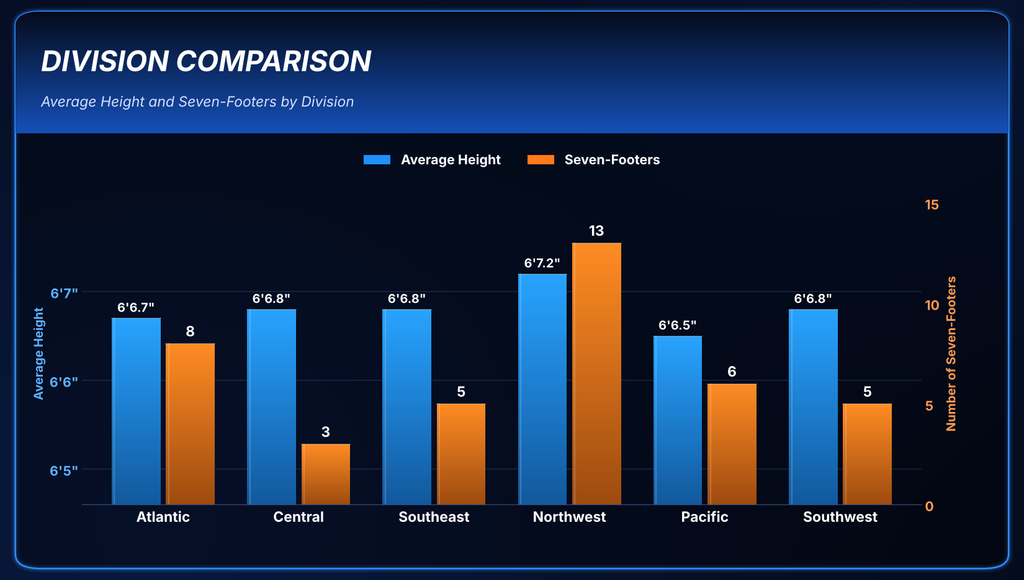
The NBA’s height distribution highlights an interesting distinction between overall roster height and frontcourt size. A team can have a relatively tall roster without possessing a center with the length to consistently challenge opposing big men.
The Bulls’ roster is built around length and positional versatility, with players who can thrive in randomness, operate in different offensive roles and defend multiple positions. However, having several players between 6-foot-8 and 6-foot-11 is not necessarily the same as having a legitimate interior anchor.
Chicago lacks the particular combination of size, shooting and defensive impact that has become so valuable throughout the league.
The Bulls frontcourt has several players who offer different pieces of the modern big man equation. Nic Claxton provides athleticism, mobility and defensive versatility. Zach Collins offers a more traditional offensive skill set, while Jalen Smith brings perimeter shooting potential. Leonard Miller, Caleb Wilson and Matas Buzelis add length and athleticism to a young group. Yet, Jordan Hawkins and Patrick Williams have been off the bench first, before Miller or Buddy Hield in the last two games.
But none of those options are considered the type of two-way center that championship contenders increasingly covet.
Claxton, in particular, represents an interesting defensive option. His length (6-foot-11with a 7-foot-3 wingspan) and ability to defend in space fit the demands of a modern switching defense. However, his offensive profile differs considerably from the perimeter-oriented centers who force opponents to change their defensive coverage, creating a balancing act for head coach Tiago Splitter. The 27-year-old averages 10.6 points per game with 7.6 rebounds and 19% from three.
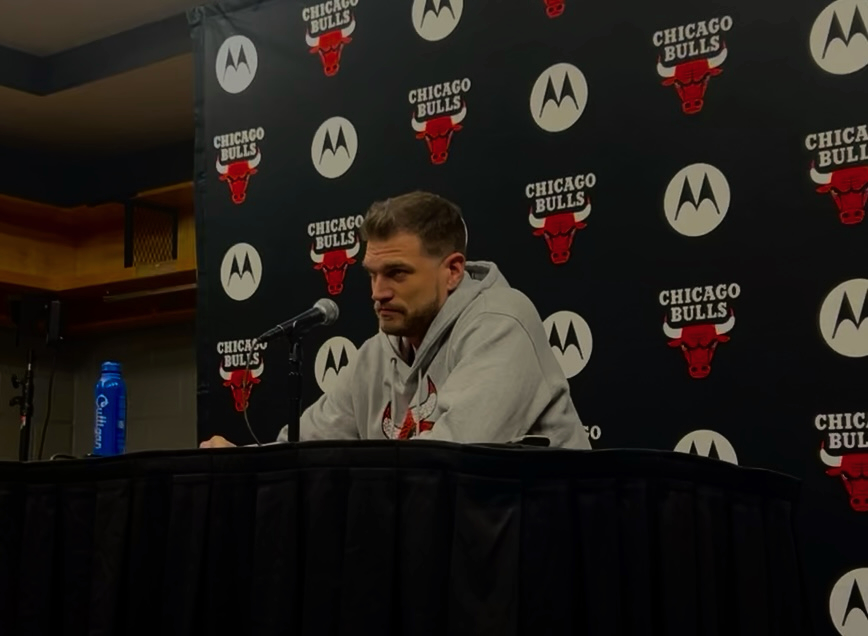
Small-ball schemes have proven effective, yet the system relies on athleticism and sharpshooting, imperative characteristics to create advantages on both sides of the ball against modern NBA teams. Thus, it’s extremely difficult to produce athleticism and sharpshooting while enduring the physical demands of facing larger and increasingly athletic frontcourts for 48 minutes. Against teams with elite contemporary interior scorers, Chicago could be forced to commit additional defensive resources to the paint, potentially compromising already shaky perimeter defense.
The opposite problem exists offensively. Without a five that consistently commands attention beyond the arc, opposing defenses can devote more attention to the paint and the Bulls’ driving lanes.
The Bulls structural exigency is not necessarily finding a player who measures astronomical heights. It’s about unearthing talents who conduct a symphony of discomfort for opposing centers, rupturing the extraordinary geometry and limiting the agency of modern unicorns. Amen Thompson demonstrated height isn’t everything, rejecting Wembanyama to seal the Rockets 122-110 win over the Spurs two weeks ago.
Bulls drop eighth straight to the surging Spurs
After a scorching first half shooting the rock, the young Bulls roster without Norman Powell (back spasms) and Wilson for the second half (right-hand injury) couldn’t withstand the defending Western Conference Finals Champions for 48 minutes.
The Bulls have now lost eight in a row and fall to 1-9 on the season and 0-4 at home. The Spurs improved to 10-2 on the season, winning their tenth straight.
After the best half of basketball this season for the Bulls, the wheels fell off in the third quarter. An all too familiar scene for Chicago fans this season. After scoring 70 points to San Antonio’s 56 in the first half, shooting 66% from the field and 67% from behind the arc. For a team shooting an NBA-low 27.2% from three, the hot streak was hardly sustainable. Especially without star rookie forward Wilson, who scored 15 points in 15 minutes before exiting.
Smith shot 5-for-5 from three and scored 23 points (tying his career high) in 30 minutes. Not that easy when 7-foot-4 Wembanyama is guarding you. Yet, the Bulls center posted a -31 +/- on the night, struggling to contain Wembanyama. Buzelis shot 3-7 from three and 5-12 from the floor, good for 13 points in 31 minutes with 6 turnovers. Josh Giddey tallied only nine points with seven assists and seven turnovers to match.
The Bulls were scoring, but couldn’t keep the handle in the half-court and struggled to defend the length and versatility of the Spurs in the second half. After Wilson went to the locker room, the wind was taken out of Chicago’s sails.
Wembanyama and Dylan Harper led the scoring for San Antonio. Harper had 18 points, 10 assists, 0 turnovers and four steals. Wembanyama tallied 32 points, nine rebounds and five blocks, with a +/- of +29.
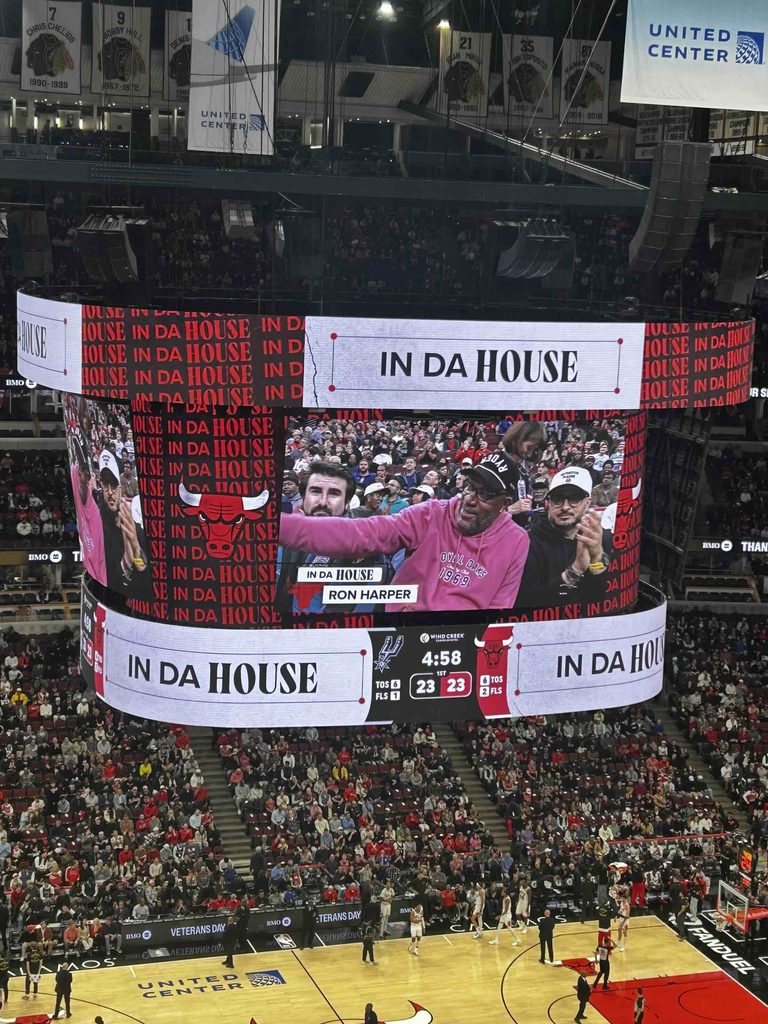
Although the Bulls couldn’t play their A game for a full 48 minutes, Smith and Wilson proved that Tiago Splitter’s scheme of shooting over Wembanyama works, at least for a short time.
Even though Smith and Wilson didn’t miss a three, their combined -50 +/- points to a larger issue. Chicago can’t rely on shooters to drain shots every game to win. The Bulls will have to play exceptional basketball on both ends to beat elite teams with the size, shooting prowess, and versatility the Spurs possess.
The 124-119 final score doesn’t tell the full story. At one point, the Bulls led by 22 (the largest lead of the season) halfway through the second quarter.
The Spurs opened the third quarter with an 18-3 run and never looked back.
If Wilson and Norman Powell aren’t available, other players are going to have to fill in the scoring void for Friday’s matchup against the Atlanta Hawks.
Searching for the next unicorn
For Chicago, the hunt should not begin or end with a measuring tape.
The Bulls need to determine whether their young frontcourt can develop into a group capable of defending elite centers, controlling the glass and creating enough offensive spacing to prevent opponents from packing the paint.
If not, the trade market and future draft classes become increasingly important avenues to locate the missing pieces for Executive Vice President of Basketball Operations, Bryson Graham. One of those future unicorns was on display at the United Center Tuesday night: the 17-year-old, 7-foot-2 Joaquim Boumtje Boumtje for the Duke Blue Devils.
The ideal target would be a center who can protect the rim without sacrificing perimeter defense, shoot well enough to pull opposing big men away from the basket and provide additional offensive dimension through passing or post scoring.
Those players are exceptionally difficult to find. When a team does discover one, they often covet them.
Chicago’s average roster height may be among the tallest in its division, but that doesn’t necessarily translate into a frontcourt advantage.
The Bulls have length, athleticism and a collection of young players with room to develop. What they don’t have is the type of established interior presence that can dictate matchups against the league’s best teams.
The NBA is no longer asking whether a center can shoot. It’s asking whether the five can shoot, defend, facilitate and protect the rim, sometimes all in the same possession.
Finding that player is the next challenge for Graham.
In a league where the best big men can shoot, facilitate, protect the rim and defend in space, finding one player who can do it all has become one of basketball’s greatest competitive advantages. It’s akin to finding a triple threat in theater (someone who can sing, dance and act) or a five-tool baseball player (an athlete who hits for average, power, can run exceptionally fast, field at the highest level and has a cannon for an arm).
Amen Thompson blocked Wembanyama to seal the game two weeks ago. Not every player has to be seven feet tall to make an impact. In a league increasingly defined by colossal competitors who are Swiss Army Knives on both ends of the floor, the Bulls desperately need to find players who can make their team as difficult to attack as it is to defend.
For Graham, the challenge is determining whether Chicago’s young team can develop those qualities collectively or whether the squad necessitates a restructuring. The answer will shape how the Bulls build around their young nucleus and whether Chicago can keep pace with an NBA that continues to evolve positional definitions.
The graphs in the article were made with the assistance of Claude at the direction of the author.

