





Badgers dominate No. 16 University of Southern California 24-7 as a resurgent defense, a more controlled offense and renewed interest at Camp Randall signal a potential turning point.
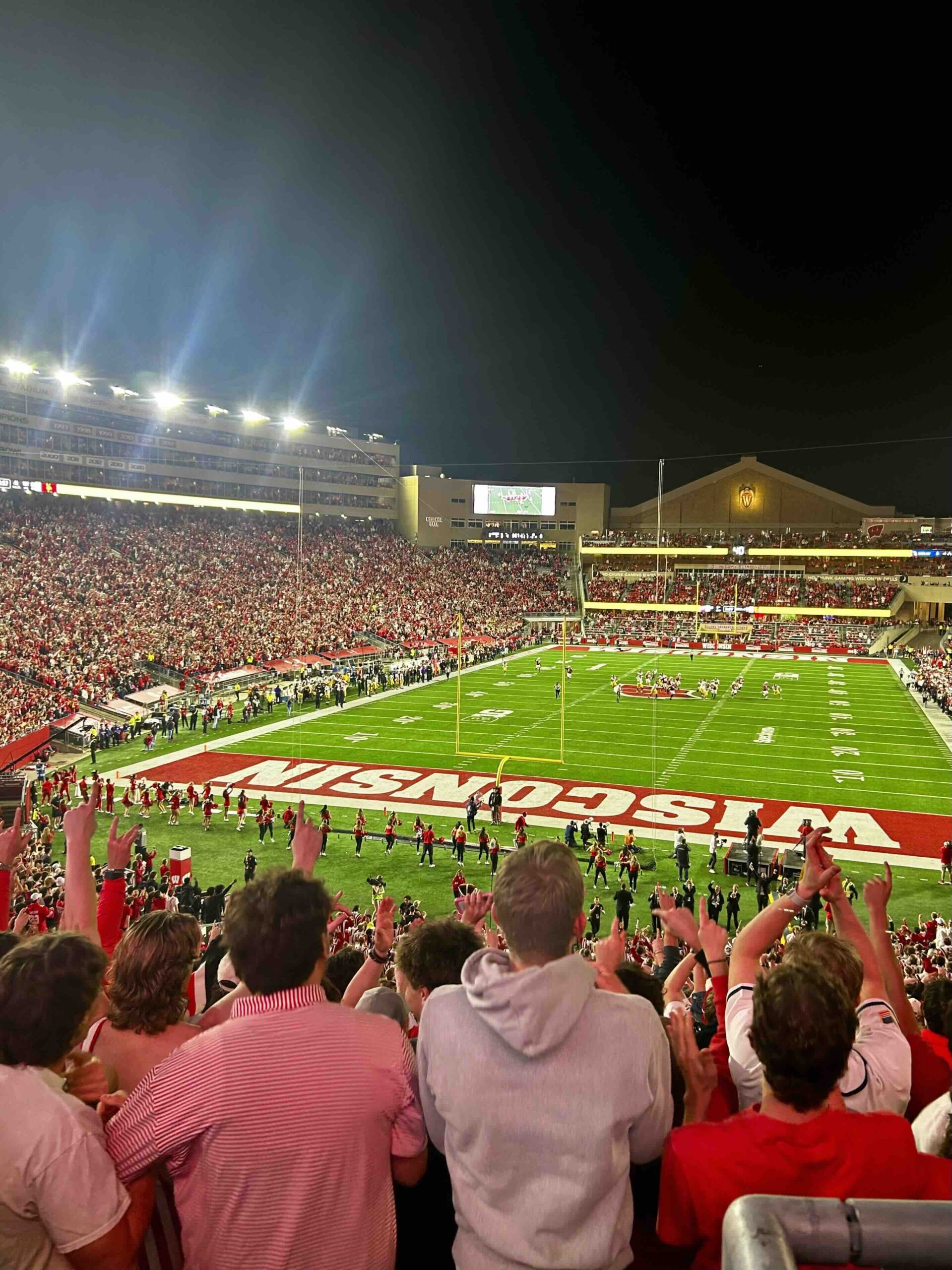
MADISON—Wisconsin football’s resurgence is beginning to show up in the stands. The Badgers drew 71,750 fans to Camp Randall Stadium for their 24-7 victory over No. 16 USC on Oct. 24, their largest home attendance since hosting No.1 Ohio State on Oct. 18, 2025, when 72,795 fans attended.
The crowd fell 1,045 short of the Ohio State game’s attendance, underscoring the renewed interest surrounding a Wisconsin team that improved to 5-2 overall and 3-1 in Big Ten play with the victory.
After a disappointing 7-6 campaign in 2025, Wisconsin has given its home crowd reasons to believe the program is moving in the right direction. The victory over USC marked another significant step, as the Badgers controlled the game defensively and secured their second win over a ranked opponent this season.
Wisconsin’s defense overwhelmed the Trojans, the offense leaned on a physical running game and quarterback Colton Joseph delivered an efficient performance without being asked to carry the passing attack.
For a program trying to reestablish itself among the Big Ten’s contenders, the performance offered a blueprint. The question now is whether Wisconsin can reproduce it against another ranked opponent on the road.
A defense that can change the Badgers’ ceiling
Wisconsin’s defensive performance was the clearest reason for optimism.
The defense simply dominated, limiting USC to just 241 yards of total offense, including minus 17 rushing yards. The Badgers recorded five sacks, forced two interceptions and held the Trojans scoreless in the second half. USC managed only 3.2 yards per play across 75 offensive snaps.
The defensive front set the tone by consistently disrupting quarterback Jayden Maiava. Wisconsin’s pass rush forced him into difficult situations, while the secondary capitalized on mistakes. The combination prevented USC from turning its 31 completions into sustained scoring drives.
The two interceptions were particularly important. Wisconsin turned the first-half takeaway opportunities into field position and kept the Trojans from building on their only touchdown (a four-yard pass from Jayden Maiava to Taniela Toupou in the second quarter).
Wisconsin’s defense also received a boost from special teams. Junior Poyser blocked a 44-yard field goal attempt late in the third quarter, preserving the Badgers’ 10-point advantage at the time.
The performance suggests Wisconsin has the defensive personnel to frustrate high-powered offenses when its pass rush and secondary work together. The larger test is consistency. One dominant night doesn’t guarantee the same result against every opponent, but holding a ranked USC team to seven points provides a meaningful benchmark for the unit.
Colton Joseph finds his role
Wisconsin did not need Joseph to put up a prolific passing line to beat USC. It needed him to protect the football, make timely throws and help sustain drives.
Joseph completed 12 of 14 passes for 58 yards and a touchdown without an interception. His most important throw came on fourth and two in the third quarter, when he connected with Chris Brooks Jr. for a 16-yard touchdown that extended Wisconsin’s lead to 17-7.
The passing total was modest, but the efficiency mattered. Joseph completed 85.7% of his attempts and avoided the turnovers that plagued USC. His ability to contribute as a runner also gave Wisconsin another option when plays broke down or the offense needed to move the chains.
The performance points towards a practical formula for Wisconsin: Joseph doesn’t have to win games through volume passing if the defense creates opportunities and the running game controls possession.
Still, the Badgers will need to demonstrate that their passing offense can produce more consistently when opponents successfully limit the ground attack. Against USC, the balance tilted heavily toward the run and Wisconsin finished with 200 total yards. The victory showed Joseph can execute within the structure, but tougher matchups will demand more from the passing game.
The running game returns to the stage
Wisconsin’s offensive identity has been “tough, nasty and disciplined” and the victory over USC was a testament to their disruptive nature.
The Badgers ran 43 times for 142 yards and two touchdowns, averaging 3.3 yards per carry. Abu Sama III led the team with 71 yards and 17 carries, while Bryan Jackson added a five-yard touchdown against his former team in the second quarter. Ryan Schwendeman’s one-yard touchdown run in the fourth capped the scoring.
The numbers were not spectacular on a per-carry basis, but Wisconsin repeatedly returned to the ground game and kept USC’s offense off the field. The Badgers were relentless, possessing the ball for 32 minutes and 36 seconds, compared with USC’s 27 minutes and 24 seconds.
The fourth-quarter touchdown drive illustrated the approach. Wisconsin marched 59 yards on 13 plays, taking more than eight minutes off the clock before Schwendeman crossed the goal line.
That kind of possession not only adds points, it also limits the opponent’s opportunities, gives the defense time to recover and forces the opposing front to defend run after run.
Wisconsin will need greater explosiveness from its rushing attack to make the formula sustainable so that it can finish drives and protect a lead without relying on a high-volume passing game.
Camp Randall responds to a team worth watching
For the first time in 44 years, the Milwaukee Brewers are in the World Series. Saturday’s game started a half hour before the Brewers played the Tampa Bay Rays in Milwaukee for Game Two of the World Series. The games overlapped, putting fans in the position of choosing between a pivotal Badgers matchup and the Brewers’ pursuit of a championship.
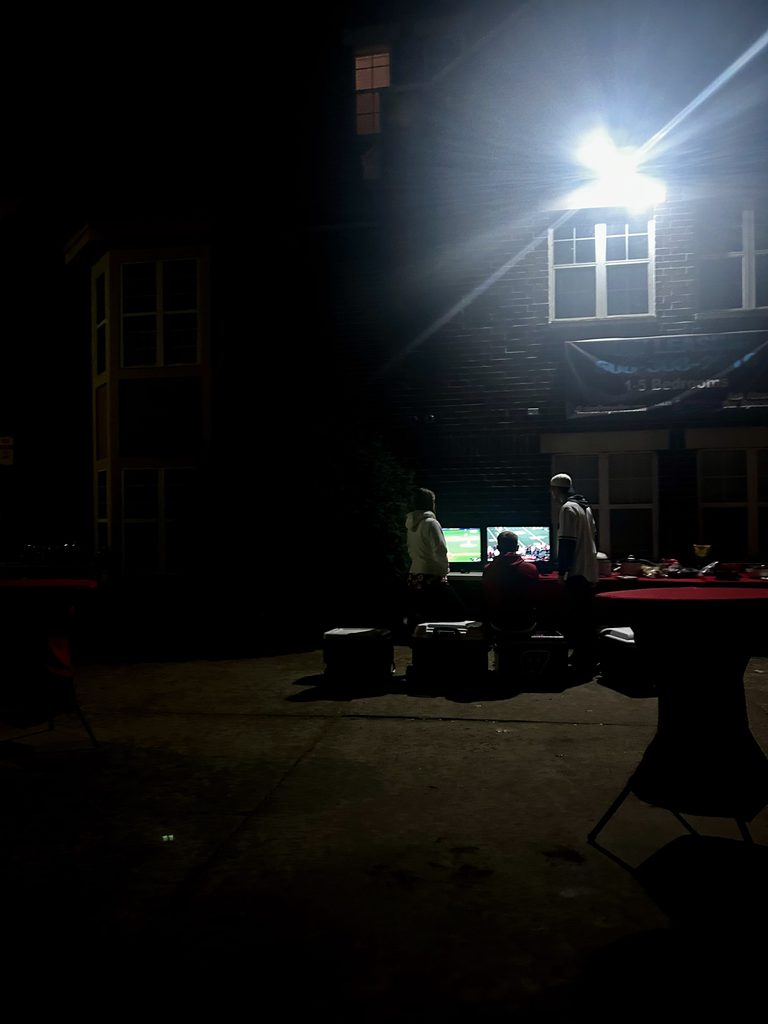
For some fans, there was no need to choose just one. Outside Camp Randall, televisions showed the competing game as fans gathered around screens during tailgates; inside, fans streamed the game on their phones while taking in the dominant Badgers’ performance.
The scheduling conflict makes the attendance figure particularly notable; the 71,750 represent Wisconsin’s largest home crowd since the Ohio State game in October 2025, when 72,795 attended. The USC crowd was only 1,045 below that mark.
The attendance alone cannot measure a program’s health. Marquee opponents, kickoff times and the broader college football calendar all influence turnout. But a crowd of that size for a team coming off a 7-6 season reflects the enduring appeal of Wisconsin football when the team gives supporters a reason to believe.
The victory, which led to Wisconsinites storming the W, gave those eager fans something tangible to take away: a ranked opponent held to seven points, a defense that consistently pressured the quarterback and an offense that closed out the game with a long touchdown drive.
Wisconsin improved to 5-2 overall and 3-1 in Big Ten play, adding a second victory over a ranked opponent after its 24-20 win at then No.13 Penn State on Sept. 26.
The triumph signals a meaningful shift from last season’s 7-6 finish, but the challenge now is to sustain it. The Badgers cannot rely on a dominant defensive showing every week and the passing game still has volumes of room to grow.
The crowd has shown it will respond to progress, even with conflicting sporting events. The next challenge is sustaining that interest. Winning games like this gives fans a reason to return; stringing together those performances could turn a promising night at Camp Randall into a lasting resurgence.
The next test
Wisconsin’s win over USC was not a complete offensive performance, nor does one result establish that the program has returned to the Big Ten’s upper tier. It was, however, the kind of win that can change the tone of a season, propelling the Badgers back into the AP Top 25 poll for the first time since Week 2 of the 2023 season.
The defense showed it could dictate terms against a ranked opponent. Joseph demonstrated that he can protect the football and deliver in key moments. The running game provided the foundation for a fourth-quarter finish.
Together, those elements give the Badgers a workable identity: defend aggressively, run with purpose and rely on the quarterback to make the right plays at the right time.
With 71,750 fans filling Camp Randall, Wisconsin looked and played like a program beginning to regain its footing.
Wisconsin heads to Iowa this weekend to face a 5-2 Hawkeyes team, the last serious test before the axe game to cap off the season against a solid 5-2 Minnesota Gophers team.
The attendance was a sign of renewed interest. The win was a reason for it.
The challenge for Luke Fickell and the Badgers is to finish strong and make sure neither is temporary.

