






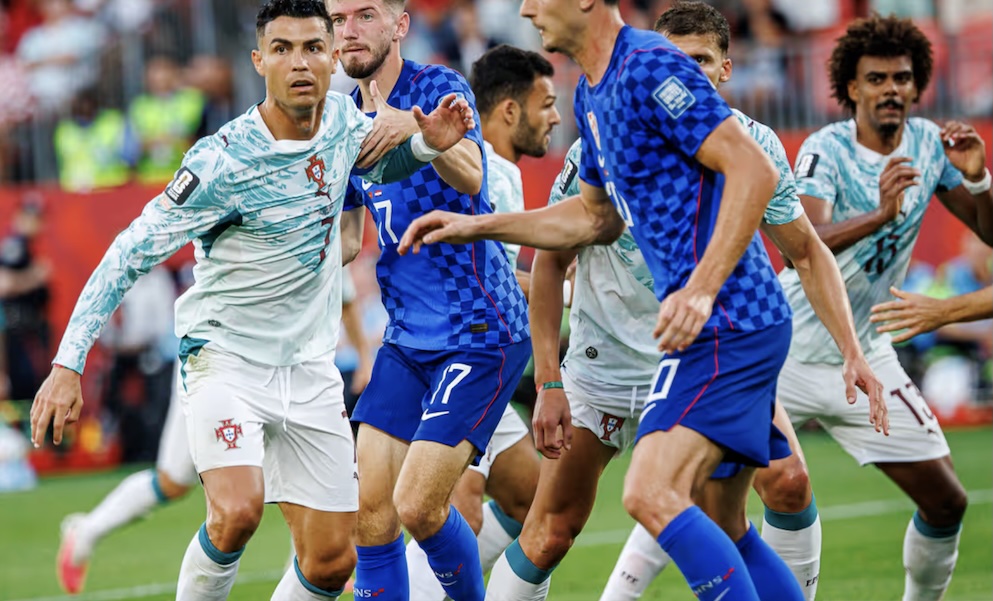
A few nights ago, Croatia thought it had prevented its World Cup elimination. Josko Gvardiol scored a goal deep into stoppage time against Portugal, the bench emptied, fans screamed, and then it all got wiped away. Offside, by the tiniest of widths, detected by a sensor buried inside the ball. No human eye caught it. No replay caught it. A chip did.
I’ve been a soccer fan for almost sixty years, and I started my career in sports radio back in the late 1970s. I’ve watched this game go from having almost no technology at all to VAR, goal-line technology, semi-automated offside, and frame-by-frame reviews that measure a shoulder to the centimeter. And watching that Croatia goal disappear, one thought kept nagging at me:
If we trust technology to decide whether a player’s hair is a fraction of an inch offside, isn’t it finally time we trusted it to keep the clock?
Here’s the idea, and it isn’t complicated. Connect the referee’s watch to the stadium clock. When play officially stops, whether an injury the referee has to step into, a goal, a substitution, a VAR review, a card, any real interruption, then the clock stops with it. When play resumes, it starts again. What fans see on the scoreboard would finally be actual playing time, not a number the fourth official holds up on a board while everyone squints, and an unknown precision as to when the clock hits zero.
You could even borrow one small idea from American sports without turning soccer into something it isn’t. In the final couple of minutes, stop the clock when the ball goes out of play. That alone would gut the deliberate time-wasting we all detest. The goalkeeper who suddenly develops a limp, the throw-in that takes a full minute to take. Say what you want about American sports, but they get one thing right. Everybody in the building knows exactly how much time is left.
And that’s really the point. The referee has been the game’s sole official timekeeper since it was codified back in the 19th century. His watch is the law, and the only source for time measurement. Once the game reaches ninety minutes, the big clock on the scoreboard is basically a suggestion. That made all the sense in the world in 1890. It makes a lot less sense in a sport that now has a computer chip in the ball and we have access to 21st century electronics.
The biggest win here wouldn’t even be fairness. It would be clarity. Players, coaches, referees, broadcasters, and every fan in the stadium and on the couch would know exactly how much time remained. No more arguments about whether the whistle came a beat too early or too late. No more wondering whether four minutes was really enough after two substitutions, a goal celebration, and a VAR check that ate up three minutes on its own.
To be fair, FIFA and IFAB have looked at this, and they went a different way. Instead of a stop-clock, they told referees to calculate added time far more precisely. After the 2022 World Cup, refereeing chief Pierluigi Collina made the case that the goal wasn’t longer matches, just honest ones. time lost to celebrations, injuries, substitutions, VAR, and delays actually being given back. IFAB’s Laws already require the referee to account for all of it. Their answer, in short, was better estimating. My question is simpler: why estimate at all?
The defenders of the running clock have real arguments, and I’ll give them credit. They say the continuous clock is part of soccer’s rhythm, its heartbeat. ninety minutes that flow without interruption, unlike the stop-and-start of football or basketball. They worry a stopped clock invites more commercial breaks, or tempts teams into longer tactical pauses since the clock wouldn’t be punishing them. Those concerns come up every single time this gets debated, and they aren’t crazy. However, we’ve already seen Fox sports take advantage of the hydration break to show ads, even though FIFA president Gianni Infantino claims that all the sponsorships were in place.
But plenty of fans see it the other way, and so do I. A visible stop-clock wouldn’t create controversy, it would kill it. Just like watching a video replay of the buzzer beating shot attempt, Any shot on goal would have to be enacted by the player. Online you’ll find no shortage of fans begging for the clock to at least stop for VAR reviews, with a lot of them ready to go further for injuries and substitutions too. Rugby has done exactly this for years: the referee stops the clock for the big delays, and the end of a rugby match is one of the least confusing finishes in all of sports.
My view is simple. If the sport already trusts technology to judge goals and microscopic offsides, it can trust technology to measure time. We’ve placed a chip in the ball the power to determine onsides or offsides. Surely we can hand a clock the job of telling us when the game is over.
Which brings me back to Croatia and Portugal. Had a real stop-clock been running that night, the confusion over exactly when the match should have ended might never have surfaced. The goal still might have been disallowed, the sensor doesn’t care what the clock says. But at least every player on that field, and every one of us watching, would have known precisely how much time was left, and whether or not the header took place before the end of regulation, instead of guessing.
The game has modernized everywhere else. It’s about time the clock caught up.

